


Prefab home delivery: how a factory-built home gets to your front door
Drawings, factory build, transport, customs, foundation, assembly, hookups and inspections: what happens at each step, who does it and what to ask.
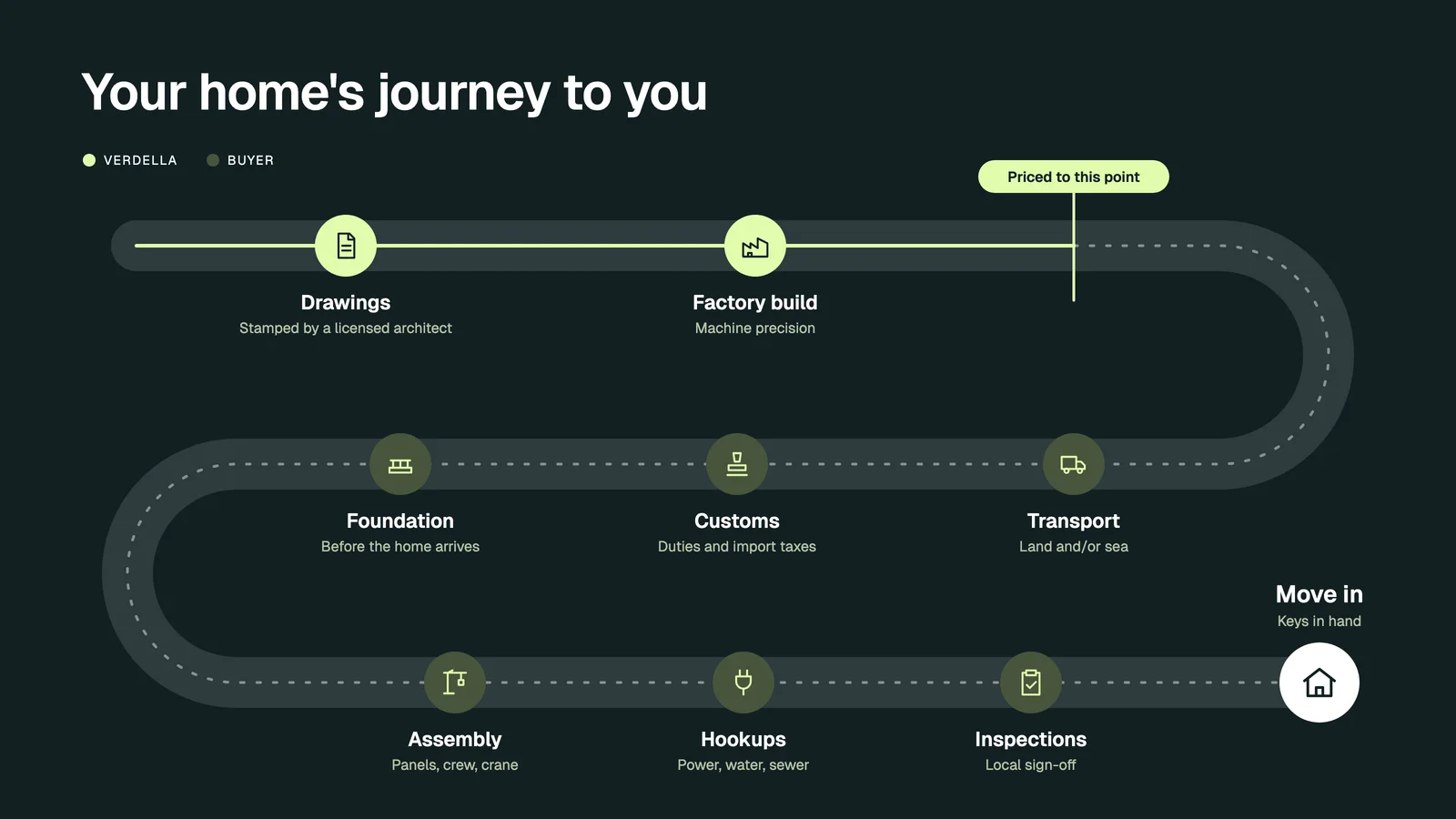
A factory-built home comes together differently from a house built on site. It is drawn first, then built in a factory while your land is prepared. After that it is shipped, assembled on your foundation, connected to your utilities and inspected. If you haven't been through prefab home delivery before, it isn't obvious what the steps are or who handles each one.
This guide walks through them in order, from the stamped drawings to the day you get the keys. For each step it says who usually does the work, what drives the cost, and what to ask for in the quote, so nothing on your budget comes as a surprise.
You won't find typical amounts here. Every one of these costs depends on your country, your plot and your contractors, and a number that is wrong for your site does more harm than no number at all. The quotes you collect will be right.
What the Verdella price covers
The Verdella price covers your home up to the moment it leaves our factory, loaded onto transport, together with the architectural and structural engineering drawings stamped by a licensed architect. In trade terms this is called ex-works (EXW) pricing. Everything after the factory gate, from transport to the final inspection, is arranged by you or by the contractors you choose.
Pricing it this way means the house price doesn't depend on how far your site is from the factory. Every home leaves with the same published inclusions list for its tier. What changes from one project to the next is everything after the gate: the distance, the trade rules between countries, the land, the permit, local labor and the utility work.
Pricing those separately means you see exactly what you pay for the house itself, and you can hold it up line by line against any other seller. Many factory-built homes are advertised with one headline number. Some include transport or assembly, some leave out the interior, and few say which. If you want the full list of what each Verdella tier includes before it leaves the factory, read what's included in a Verdella home price.
The prefab home delivery process at a glance
Stage | When it happens | Who usually does it | What drives the cost |
|---|---|---|---|
Land and permit | Before you order | You, or an architect or builder for you | Local fees and the conditions of your plot |
Foundation and site preparation | While the factory builds | A local contractor | Ground conditions, foundation type, site access |
Factory handover and loading | When your home is finished | Verdella loads it; your haulier collects | Included in the Verdella price |
Transport | Right after loading | A haulier or freight forwarder | Distance, route and the number of loads |
Customs and import | At the border | A freight forwarder or customs broker | Duties and import taxes under the trade terms between Ukraine and your country |
Unloading, crane and assembly | On delivery day and after | An assembly team and a crane operator | Crane size, days on site, local or travelling crew |
Utility connections | After assembly | Your utilities and licensed installers | Distance to the mains, connection fees |
Inspections and move-in | During the work and at the end | Your local authority | Local rules and fees |
Land and permit, before you order
Every Verdella home comes with full architectural and structural engineering drawings, including the foundation, electrical and plumbing plans. You, or an architect or builder acting for you, take them to your local building department and apply for the permit. Verdella supplies the drawings. The application itself is yours, because the rules and the forms are local.
If you haven't bought land yet, ask three questions before you do. Does the local plan allow a factory-built home on this plot? Can a truck and a crane reach the spot where the house will stand? Are power, water and sewer at the boundary, or will they need to be brought in? The answers shape several of the costs further down this list.
Costs at this stage: the land, permit and application fees, and any surveys your authority asks for.
Foundation and site preparation, while the factory builds
Here the factory model saves time. Once your design is approved, your home goes into production and your site is prepared at the same time. On a traditional build these happen one after the other.
A local contractor builds the foundation to the Verdella drawings. Depending on the ground and the design, that is a concrete slab or helical piles. The foundation has to be finished, and a concrete slab fully cured, before the home arrives, because the crane sets the walls and floors straight onto it. Plan the foundation so it is ready a little before the delivery date, not on the day.
Ask your contractor:
- Is the foundation built to the Verdella drawings, with the tolerances they specify?
- Are the openings for water, sewer and power cables placed where the plans show them?
- Is clearing, levelling and a hard standing area for the crane included?
Factory handover: where the Verdella price ends
When your home is finished, it goes through the factory's checks before anything ships: a panel-by-panel structural review, a pressure test of the plumbing and electrical rough-in, a waterproofing test, an airtightness tape inspection and a photographic punch list.
Verdella homes are panelized. The walls, floor cassettes and roof cassettes are built as finished elements and travel flat. On the Semi-Finished and Turn-Key tiers, the windows and exterior doors are already fitted and sealed in the panels, and on Turn-Key the interior finishes are done as well. The elements are then loaded onto your transport at the factory. Loading is part of the Verdella price.
This is the handover point. From here on, the home is in your hands and your haulier's. Ask your freight forwarder about cargo insurance for the journey.
Transport to your site
Within Europe, homes travel by truck, and the drive usually takes two to three days. Homes for the United States go by container, and the sea freight takes about 45 days. The number of trucks or containers depends on the floor area of your home, so a larger home means more loads.
When you ask a haulier or freight forwarder for a quote, ask:
- How many trucks or containers does this model need?
- Is the price door to door, right up to your site?
- Is crane unloading included, or do I hire the crane separately?
- Can the delivery date be fixed to fit my foundation schedule?
- Is cargo insurance included?
Customs and import
Verdella's factory is in Ukraine, in Europe but outside the European Union. That makes a home delivered to Germany or anywhere else in the EU an import, even though it travels only a few days by road. Someone has to file the customs declaration, and import VAT is due when the goods enter. Whether any duty applies depends on the trade terms between Ukraine and your country. In the United States, a licensed customs broker files the entry.
Your freight forwarder or a customs broker handles this paperwork for a fee. VAT-registered businesses can often reclaim import VAT, and private buyers usually can't, so ask your tax adviser how it applies to you. Tell us early who your broker is, so the shipping documents they need are ready when your home leaves the factory.
Unloading, crane and assembly
On delivery day, a crane lifts the elements from the truck onto the foundation, and an assembly team joins them: walls onto the floor, then the floor and roof cassettes above. Ask your assembly team how many days on site your model needs.
Who does the assembly:
- In Europe, Verdella can recommend assembly teams we know. Their work is priced separately and agreed directly with you.
- In the United States, we are building our assembly network. Ask us what is available in your area.
- Your own builder can also assemble the home from the Verdella drawings.
What drives the cost here is the crane (its size and how many days you hire it), the number of days the crew spends on site, how easy the site is to reach, and whether the crew is local or travels to you.
What's left after assembly depends on the tier you bought:
Tier | What remains after assembly |
|---|---|
Shell | The exterior envelope and the whole interior, by your contractor |
Semi-Finished | The finishing trades, then utility connections |
Turn-Key | Utility connections only |
Utility connections
The home has to be connected to mains electricity, water and sewer, and to gas where it is used. A Semi-Finished home arrives with the rough-in already in the panels. A Turn-Key home has the fixtures in place too. The work left is bringing the services from the street to the house and connecting them, by your utilities and licensed installers.
Costs depend on how far your home sits from the mains, how much trenching is needed and what your utilities charge to connect. If there are no mains at the plot, budget for a well, a septic system or another local solution. Utilities often book connection dates weeks ahead, so request them as soon as you have the permit.
Inspections and move-in
Your local authority may inspect the work at several points, such as the foundation, the assembled home and the utility connections, and again before you move in. The rules differ by country and town, so ask your building department which inspections apply and book them early. Keep the stamped drawings at hand. Once the final sign-off is done and the services are on, a Turn-Key home is ready to live in.
Frequently asked questions
Does the Verdella price include delivery? No. The Verdella price covers the home, loaded at the factory, plus the stamped drawings. Transport, customs, the foundation, assembly, the land and utility connections are paid for by the buyer.
Can Verdella arrange transport and assembly for me? In Europe we can recommend assembly teams, priced separately and agreed with you. Most buyers arrange transport and site work themselves. If you want one team to handle the whole project, ask us. Full-service projects are possible on request.
How long does it take from the factory gate to move-in? Truck delivery within Europe usually takes two to three days, and sea freight to the US about 45 days. After that it depends on your assembly team, your utilities and your inspections. Ask each of them for their lead time and plan backwards from the date you want to move in.
Who pays import VAT on a home from Ukraine? The buyer, as the importer. Your freight forwarder or customs broker files the declaration. VAT-registered businesses can often reclaim it; ask your tax adviser.
Browse Verdella's prefab homes to choose a model, or get in touch with your plot details and we will help you list the quotes you need.


